Significant Dates 1939 – 1943
17th October 1939 – First German Bomb of WW2 fell on Hoy in the Orkneys
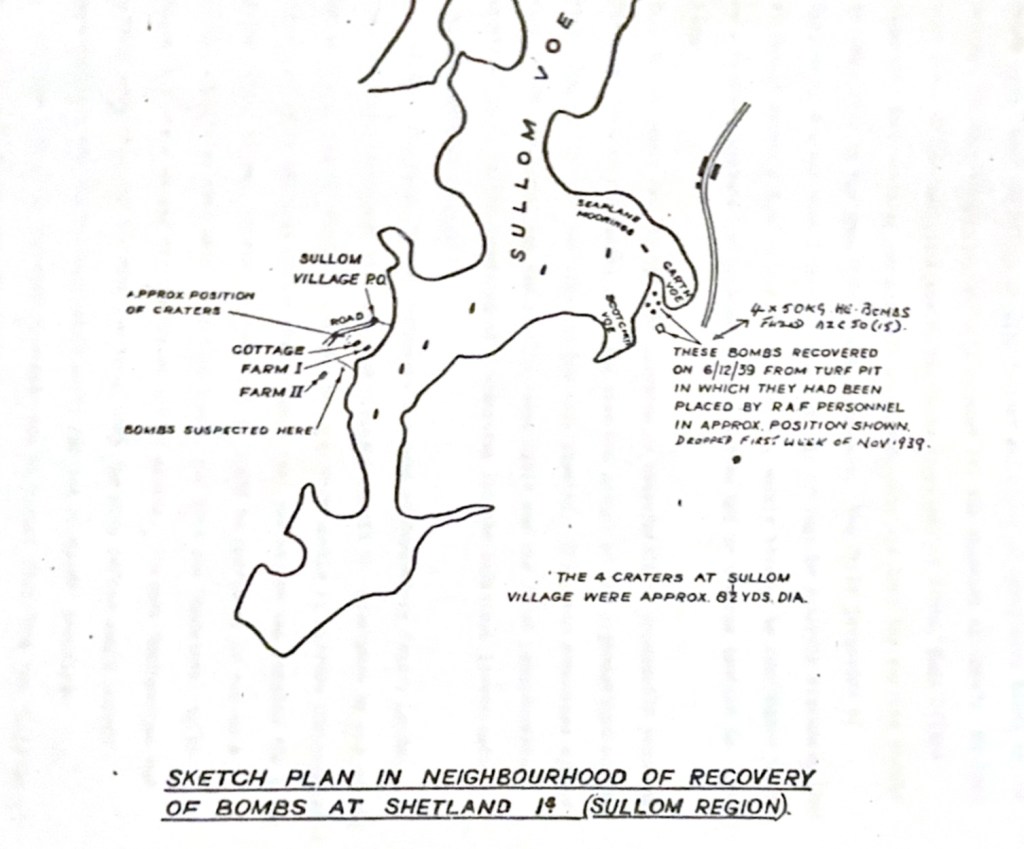
6th November 1939 – First bombs Recovered by RAF at Sullom Foe, Shetlands.
16th March 1940 – First civilian lives lost to German bombing at Bridge of Wraith in the Orkneys.
9th March 1940 – First German Bomb fell on the UK mainland near Canterbury, Kent.
10th May 1940 – First heavy German bombing attacks on RAF airfields in France.
24th May 1940 – First industrial town, Middlesborough, attacked by German bombers.
18th June 1940 – First German bombs fell in London area
1st July 1940 – First daylight raids on Wick and Hull.
8th August 1940 – Battle of Britain began.
12th August 1940 – German attacks on airfields in the south of England.
26th August 1940 – Winston Churchill visited RAF Mansion and was appalled at the damage and the quantity of unexploded bombs.
14th September 1940 – As a result of the visit to RAF Mansion Winston Churchill direct ted that RAF Bomb Disposal Squads were formed, 25 initially.
21st April 1943 – A Bomb Disposal Wing was formed consisting of 6 squadrons and 29 flights was formed.
Largest Air Munition defused by UK personnel: Probably the largest single Air munition ever tackled by a RAF BD team was a 12,000 Lb “Tallboy” dropped on Sorpe dam in Oct 44. In Dec 1958 when the dam was drained the bomb was found in ankle deep snow and mud. The work of dealing with the 3 No 47 half hour delay fuzes was dealt with by Flt Lt J M Walters (OC 6209 Flt at Butzweilerhof) and Herr Walter Mitzke a West German BD specialist. During the operation many civilians and 650 German and Canadian soldiers were evacuated from the nearby village of Langscheid. The chemical delay were the most hazardous type of allied bomb fuze at the time. Final extraction was completed Jan 6 1959 .
Winston Churchill’s direct orders. “The rapid disposal of unexploded bombs is of the highest importance. Any failure to grapple with this problem may have serious results on the production of aircraft and other vital war material”.
Ordnance quantities 39-41. From 1939 to May 1941 the RAF BD organisation dealt with 1,512 enemy bombs and the Air Ministry Officers a further 114. None of these totals included bombs recovered from crashed aircraft, German or British. The Air Ministry quoted the number of weapons cleared in the UK (Including UK and allied origin) at the end of WW2 as some 83,700 weapons.
Tactical deployment with 2nd Tactical Air Force. As part of the Second Tactical Air Force RAF BD deployed as 3 man BD Squads with the invasion forces wherever there were airfields likely to be attacked, work was not just bombs but mines, V weapons and booby trap clearance. These were taken from existing flights in the UK and classed as field forces, in total approximately 50 Officers and 409 airmen were deployed with the 2ND TAF. Additionally personnel were attached to 21 Army group (believed to be 144 men), geographical areas ranged from:
North Africa, A combined operation with many units from RAF BD, 18 BD Company RE and 352 Indian BD Coy RE. Some 11,118 tons of bombs and 35,000 tons of shells were completed in 1944 from Tobruk, Mersa Matruh, Derna, Berka and Bernia district.
India, under Indian Air Command approximately 14 Squads operated.
Egypt
Malta
The Far East
Europe, Including France, Holland, Germany, Belgium, Austria, Italy, Norway, Denmark, Corsica, Algeria, Sardinia, Greece and Yugoslavia in total, approximately 13 Squads operated.
China, Flt Lt Charlton notably arranged for Japanese bombs and fuzes to be shipped to the UK for exploitation.
D Day . Forty two RAF BD personnel actually landed on D Day with the invasion forces. This was followed by more later, until at its height some 400 in 12 BD flights were deployed clearing the debris of war.
By VE day, it was calculated that RAF BD units had dealt with some 84,000 weapons in the UK and 92,000 in mainland Europe. After this between May 1945 and Jun 1947 RAF BD units disposed of 163,000 tons of HE bombs, 13,500 tons of pyrotechnics and 195 million rounds of ammunition (This included 28,088 tons of chemical and 4,370 V weapons.
Hitler’s V Weapons . Around Jun 1945 2 Flights of RAF BD recovered and removed over 150 V2 weapons from the vast “secret weapon” underground establishment at Nordhausen, Germany.
Chemical weapons approximately 28,088 tons of chemical weapons were destroyed by the air disarmament organisations.
Post WW2 overseas operations in more detail:
Operation CHALLENGER, Suez. In October 1956 a flight (6204) from 5131 BD Squadron assembled at RAF Yatesbury for operations in the Suez area of Egypt. They were flown to Malta in a Shackleton aircraft after which they embarked on the aircraft carrier “Ocean” which set sail with the British Force to Suez. At first light on 5 Nov 56 the force started landing, a small team of EOD was airlifted to the civil airport at El Gamil just outside Port Said which at the time was behind enemy lines. The remainder set down on the beaches by landing craft under considerable Egyptian fire power, once this was quelled the road to the airport was opened and the teams linked up. Work started on 6 Nov to clear the Airport of explosives (including British bombs) and general explosive clearance of the Port Said area. This included amongst other BD tasks searches of buildings for weapons and booby-traps, as tasks diminished the teams were used to repair firearms and escort vehicles and VIPs around Port Said. In Dec 56 the Flight were stood down and returned by sea to Plymouth.
Indonesian confrontation Far East 1964. Forty four NCOs AND airmen deployed to the Far East from 5131 BD Squadron at 24 Hrs notice in Sep 1964 under emergency drafting procedures. These BD men were needed to supplement the Far East Air Force (FEAF) armament staff in the confrontation operations against Indonesia who had been threatening Sarawak, North Borneo and Malaysia ever since the Brunei rebellion in Dec 1962. However, the confrontation did not develop into a “Hot war” so most of the men were repatriated to the UK by Dec 1964.
Cyprus emergency Operation TOSCA, after the Turkish air attacks on Cyprus during the invasion in 1974 the first line EOD team at Akrotiri, whose members were drawn from the Weapon Engineering Squadron was called out to deal with unexploded ordnance delivered by F100 Super Sabres, Starfighters and Thunderstreak aircraft of the Turkish Air Force, they used a mixture of 500 Lb and 750 Lb GP bombs together with 2.75” HEAT ro ckets and 20mm ammunition. During a ceasefire Flt Lt Costick, Fg Off Wilson and CT Knox swept two towns and found two 750 Lb bombs one under a church and the other six floors up in the Venus Beach Hotel. The American cocked striker of the latter was removed using IGOL for which Flt Lt Costick latter received the QGM. The international airport at Nicosia was subject to a full sweep by the EOD team this led to recovery of further bombs, mortars and rockets which were removed and demolished in a nearby quarry. Other areas where bombs were recovered was in the Paphos area (2 bombs in the harbour and 2 on land, also a 500 Lb bomb was disposed of near a UN observation post. Other members of the teams not mentioned included Flt Lt Tout MBE, FS McDermott, JT’s Daly and Wood and SAC Dennis.
Operation CORPORATE, Following the invasion of the Falkland Islands by the Argentinean forces in 1982 at task force was assembled and dispatched to the South Atlantic. As Air Power would play a major role RAF Bomb disposal dispatched 1 Officer, 1 WO, 4 SNCO’s and 5 airmen. The detachment left the UK by Air to the Ascension Islands on the 7 May 1982 where they embarked on the LSL Sir Bedivere sailing to San Carlos sound where they arrived on 23 May. During air raids on the anchored ships UXBs were reported on various ships, RAF SNCO’s visited the HMS Galahad and Lancelot to give advice on the types of bombs and fuzing components. The unit then disembarked on 25 May to Ajax Bay, after two days of air raids by Skyhawk’s the rear of the hospital complex was bombed. Two bombs exploded killing five and wounding 26 personnel, one UXB was located on the hillside and blown safely, however two hours later a further two UXBs were discovered one buried in a refrigeration unit and one in the roof space previously used for accommodation. Both were of an unknown type and posed a threat to the hospital area of the building, it was decided to leave them in situ (some mitigation measures were put in place) to allow the operating room to continue functioning. To give the staff and patients confidence in the decision the RAF EOD unit slept in the hospital. As a result of bombing stockpiles of munitions around the hospital were scattered over a wide area, this included the helicopter strip which was classed as a priority asses and prioritised for clearance. Over the next two hours over 250 items of damaged ordnance was removed from the area without incident. Following this the Area Commander tasked the team as required to a variety of LSO, UXB’s and missiles. On the 30 May the team was tasked to Goose Green to commence the enormous task of clearing the settlement and airstrip. The priority was to move containers of Napalm (weeping and with a risk of “spark” ignition) to a safe area of the Airfield for demolition (over 17 tonne destroyed). By the end of the task Pucara aircraft had been disarmed, ordnance demolished, over 600 bomblets cleared from known cluster bomb sites. Even other tasks such as servicing of captured LMG’s was completed to enhance 7 Ghurka Brigade’s firepower. Further bombs were reported outside Brigade HQ at Darwin where IGOL was used to remove a No 78 Mk 2 tail pistol, two 1000 Lb bombs were later destroyed on a local beach. The team then moved to Stanley Airport to conduct clearance operations, this included runways been checked, ordnance demolished, aircraft cleared of booby-traps and cluster bomb sites cleared. On the 10 Jul 82 the EOD team set sail for Ascension to return to the UK. For the teams part in Operation CORPORATE Flt Lt Swan was awarded a QGM, FS Knights a Mention In Dispatches (MID) and two airmen (JT Thorne and SAC Soppet-Moss) QCBC. The remaining airmen all received a Task Force Commanders Commendation.
Operation GRANBY, Iraqi forces invaded Kuwait on 2 Aug 1990 coalition forces were dispatched at the request of the Saudi Arabian government to support Saudi Arabian forces against a possible incursion from Iraqi troops. Once it was clear that Iraq was ignoring the UN resolution to withdraw from Kuwait an offensive force of coalition partners was assembled in Arabia and a deadline declared. During this time personnel were detached to Bahrain to conduct Self Contained Breathing Apparatus (SCBA) training and reinforce and establish a viable EOD organisation on that unit. EOD teams comprised of RAF, USAF, RSAF and BAe personnel. From then on they performed a variety of EOD tasks while being on the receiving end of regular SCUD attacks. GRANBY was an example of using first line station EOD teams in their secondary capacity while the EOD Squadron was declared on standby for the hostilities but was not required!
Operation ROCKINGHAM, Iraq. As part of the cease fire post Iraq conflict UN teams under the UN mandate were permitted access to specific military locations to destroy SCUD missiles, warheads, chemical weapons and nuclear assets. Iraqi chemical assets were found to be more extensive than thought, taking considerable time to inventory.UK involvement in the UN inspection teams was designated Operation ROCKINGHAM, Flt Lt Coslett, OC EOD Ops Flight was one of a number of UK personnel assigned to specific teams. As an EOD advisor he travelled extensively throughout Iraq with an inspection team whose mandate was to inventory chemical assets, SCUD missiles and warheads. In Dec a further two personnel from the EOD Squadron were deployed as members of UN inspection teams (Sqn Ldr Dunkley and FS Anderson).
Operation PINSEEKER, May 91. Following Operation GRANBY Kuwait and the surrounding areas were heavily contaminated with enormous quantities of unexploded ordnance. The Kuwait Government prioritised this as essential to the rebuilding of the state, to facilitate this they sought tender for contract to clear these areas and allocated areas of the country to each of the coalition partners. Royal Ordnance obtained the UK contract, and at their request through the MOD, NO 21 RE EOD was sub-contracted to work for them. This operation was codenamed PINSEEKER, in addition to the Engineers two RAF personnel FS Shaw and Sgt Roberts of Wittering were nominated to act as advisors on Air Dropped Weapons. Although initially not fully appreciated by the end of the tour both RAF SNCO’s had more than proved their expertise, knowledge and courage and were awarded praise in the RE post tour report, In addition to rendering safe 10 of the 13 Air Delivered Weapons dealt with by the RE Squadron they had liaised with and given help to a variety of other nations Armed Forces.
Operation AGRICOLA, Kosovo In June 1999 seventeen personnel from 5131(BD) Sqn deployed to Kosovo on Op AGRICOLA as part of KFOR. The 4 teams and a Commander were embedded into 21 Fd Sqn (EOD) of the Royal Engineers and entered Kosovo from a holding area in Macedonia as part of the initial entry force. The teams deployed in a mix of Spartan CVR(T) and Landrovers with one of each vehicle being allocated to each team. The entry was achieved through the mountainous Kacanik Defile as a huge convoy of personnel and equipment escorted by Paras and Ghurkas in Helicopters. Serious challenges faced KFOR upon arrival in Kosovo. Yugoslav military forces were still present in large numbers and the Kosovo Liberation Army (UCK), too, were armed and highly visible. Fighting was still going on in some areas and nearly a million people were refugees outside Kosovo. Those who remained lived in daily fear for their lives. There was little electricity or water, homes were destroyed, roads were mined, bridges down, schools and hospitals out of action.
Once the UK forces reached Pristina a base was established for the EOD forces in an abandoned Volkswagen garage on the outskirts of the city. It was from here that daily missions were carried out to start clearing the country of the thousands of items of unexploded ordnance left over from the conflict. Daily routines usually saw each team leaving base for around 12 hours and completing up to 13 tasks per day. The majority of the workload during the early stages of the campaign was the clearance of large ordnance and a vast amount of cluster munitions of both US and UK origin.
The RAF teams were initially tasked with the clearance of Pristina airfield in order to allow humanitarian air operations to begin. This task involved working closely with the Russian Military who had reached the Airfield first and often led to tense negotiations and changing priorities. The airfield had been attacked with cluster munitions and large bombs and presented a significant challenge to the EOD teams. After 4 months the number of teams was reduced across the whole EOD Group with the RAF commitment dropping to 2 teams and then down to one soon after. 5131(BD) Sqn retained a presence for a number of years until the operation ended.
Operation OCULUS, Bosnia. As part of the SFOR commitment Banja Luka metal factory was used as base for British troops for over 10 years toward the end of this era the operation became a EUFOR task entitled OP ANTHENA during which an RAF 2 man team was the UK EOD presence for Bosnia covering a range of EOD tasks including CMD reactive tasks, mine strike cover (Heli-bourne) for UK troops and liaison for the civilian EOD team. Part of the weekly routine was to visit approximately 31 Police stations throughout Bosnia to ensure explosive safety as amnesty items were regularly handed over in a dangerous state and the civilian EOD team was underfunded and resourced. By time the “Factory” closed four RAF teams had rotated through the operation.
Operation FINGAL, Afghanistan. Two teams from 5131(BD) Sqn deployed to Afghanistan as part of ISAF forces and were based at Kabul airfield where they cleared aircraft operating surfaces and buildings, as part of the early entry enabling team. In the area, numerous former soviet union air weapons and ordnance were abandoned in varying states of decay. The teams utilised WOLF Landrovers and lived in tented accommodation established by themselves on arrival. This again, was a good example of Airfield EOD teams deploying to an austere airbase with minimal support with the primary aim of enabling air operations.
Mar 2003 Operation TELIC, Iraq. RAF EOD deployed approximately 12 Airfield EOD teams to Iraq as part of the coalition to remove Sadams regime (A squadron level deployment). The primary focus for the teams was to clear Safwan airfield for allied flying operations and numerous Gas & Oil Separation Plants (GOSP’s) which were reportedly booby-trapped and mined. Some of the RAF teams crossed the start line with the US Marines and were amongst the first regular British units to enter Iraq at “H” hour. Over time the war fighting phase finished and the force returned, however on the following TELIC tours RAF EOD teams were attached to Joint force EOD group (JFEODG) who carried out numerous CMD tasks. They clearing substantial amounts of foreign and allied ordnance as well as acting as an IRT team to respond to no notice mine strikes. They worked from a variety of locations including Shaibah airfield, Basra airport (IRT team), Alamarah, Talil and Baghdad with the Mobile Collection Teams.
2010 Operation HERRICK, Afghanistan. As part of the joint Counter IED Task force 5131(BD) Sqn personnel contributed both High Threat (Neutralisation for maximum forensics) and destroy (Achieve mobility through demolition) EOD teams. At the height of the Squadrons input 13 personnel were deployed including a Flt Lt in a command role. Of note the RAF were the first Service to have a qualified High Threat Operator other than the existing RLC Operators. Teams were controlled by a HQ location at camp Bastian but spent most of their tou r deployed out to forward operating bases on a permanent basis acting as an EOD advisors to the resident infantry. Other roles undertaken right up until this day have been the mentoring of Afghan EOD teams and the bulk disposal of ordnance prior to British troops withdrawing from the area. A large amount of IED’s and ordnance were destroyed and exploited throughout the operation leading to a QGM been awarded to Chf Tech Lowe for actions including dealing with over 19 IED tasks over 3 days while on operation TOR SCHEZADA, this resulted in over 350 Kg of insurgent explosive from IED’s been recovered.
2011 Operation RECTIFY, With operational pressures DEMS Trg Regt was pushed to capacity and Defence was unable to keep up with the increased tempo, this included the forth coming London Olympic Games, RAF EOD successfully rose to the challenge and provided resources and qualified training personnel to set ups and run an additional IEDD training establishment in the austere setting of Swynnerton Training Area in Staffordshire, tasked with surge training to enable ongoing operations and sustain an increased MACA commitment caused by the 2012 Olympics.
2012 Operation HELVETIC, Northern Ireland. From 2012 onwards 5131(BD) Sqn contributed to the wider defence effort by providing High Threat Operators and No 2 assistants as required to 321 RLC EOD Sqn based in Aldergrove and Belfast, Northern Ireland. As part of the historical “Felix” unit that achieved fame during Operation BANNER the teams dealt with a variety of devices ranging from 600 Lb car bombs to numerous pipe bombs often in a politically strained environment. While on these teams RAF personnel were some of the first EOD teams to use the new CUTLASS ROV and upgraded ECM equipment on UK tasks.
Royal Air Force Bomb Disposal capability was disbanded in 2020 and all responsibility for Bomb Disposal was passed to the Royal Navy and the Army.The Royal Air Force made the decision to divest its Bomb Disposal capability with No 5131(BD)Sqn disbanding in 2020, saving the RAF £3m a year and releasing 56 personnel for reassignment to other duties across the broader RAF.
All responsibility for Bomb Disposal being passed to the Royal Navy and the Army.
Standing by to write the next chapter.
 The National RAF Bomb Disposal Memorial